Demand for Private Label NAD+ Supplements is rising with broader interest in healthy aging, energy, and cellular wellness. Yet the category needs careful interpretation. NAD+ is a coenzyme involved in cellular energy metabolism, according to the National Institutes of Health Office of Dietary Supplements. It is not a proven cure for aging, fatigue, or disease.
The market is expanding. Grand View Research reported that the global dietary supplements market reached an estimated USD 177.5 billion in 2023, with continued growth expected through 2030. However, NAD+-focused estimates vary widely. Different reports use different product definitions, regions, and revenue models. That matters.
Quality comes before attractive packaging.
This guide examines leading private label manufacturers through practical criteria. These include cGMP compliance, ingredient traceability, third-party testing, formulation support, minimum order quantities, and batch documentation. NSF and USP quality frameworks can offer useful reference points, although certification availability differs by product and facility. The U.S. Food and Drug Administration also makes clear that dietary supplement manufacturers remain responsible for product safety, labeling accuracy, and substantiated claims.
A strong supplier should provide more than a sample bottle. Buyers should request certificates of analysis, stability information, allergen statements, and manufacturing licenses. Transparent answers reveal operational maturity. Sometimes, they reveal gaps.
NAD+ products may use different forms, including nicotinamide riboside or nicotinamide mononucleotide. Their research profiles are not interchangeable. Reviews published in peer-reviewed journals suggest promising biological findings, but human evidence remains developing and formulation-specific. Therefore, the “top” manufacturer is not simply the cheapest or fastest. It is the partner that combines documented quality, responsible marketing, and realistic scientific communication.
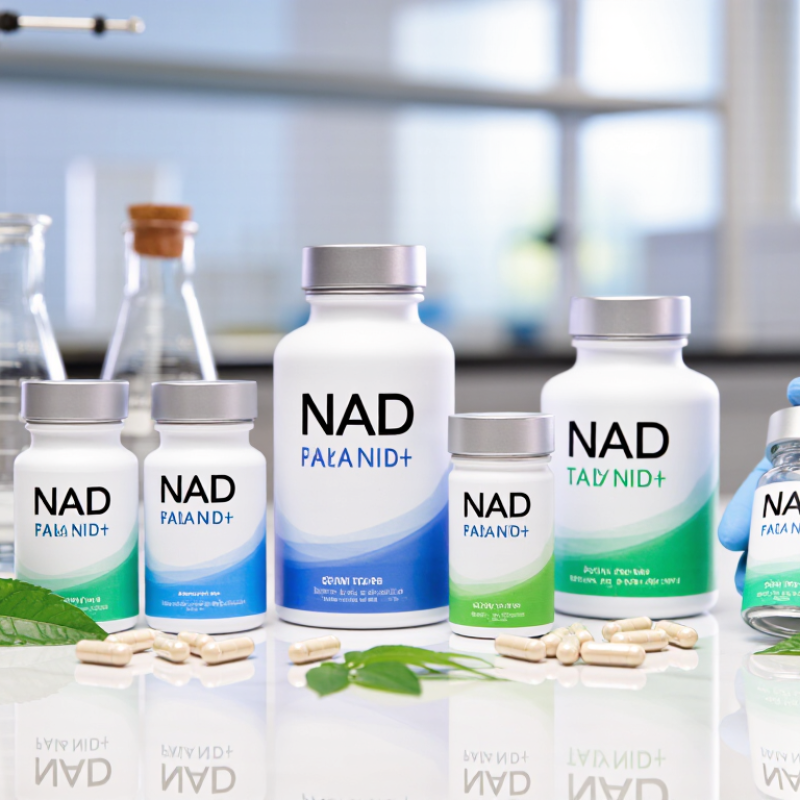
NAD+ (nicotinamide adenine dinucleotide)
is a coenzyme found in every human cell. It supports cellular energy production, redox reactions, DNA repair, and signaling proteins linked with healthy aging. NAD+ levels may change with age, but supplement claims still need careful interpretation. Most products provide precursors, such as nicotinamide riboside or NMN, rather than NAD+ itself. Direct NAD+ delivery remains scientifically uncertain.
Common product forms include capsules, tablets, powders, gummies, and liquid solutions. Capsules offer precise serving sizes and easier stability testing. Powders may suit custom private label formulations, but moisture control matters. Gummies improve convenience, although heat and sugar can complicate production.
Grand View Research valued the global dietary supplements market at approximately $177.5 billion in 2023, showing strong commercial interest. The 2023 Council for Responsible Nutrition survey also reported that 74% of U.S. adults used dietary supplements during the previous year.
These figures reflect demand, not proof of NAD+ effectiveness. Evidence is still uneven.
Tips:
Select manufacturers that follow current Good Manufacturing Practices. Request identity testing, potency results, contaminant screening, and batch-specific certificates of analysis. Check ingredient stability in the final package, not only in raw materials. Avoid dramatic disease or longevity promises. Human studies remain limited. That matters. A careful label should state the actual ingredient form, serving amount, and testing method.
Evaluating private label NAD+ supplement manufacturers requires more than comparing prices. The Council for Responsible Nutrition reported that 74% of U.S. adults used dietary supplements in 2023. That demand increases the need for documented quality, not attractive packaging. Ask whether the facility follows FDA dietary supplement current Good Manufacturing Practice requirements under 21 CFR Part 111. Request recent audit records, batch manufacturing documents, and product specifications before discussing volume.
Check the ingredient identity carefully. NAD+, nicotinamide riboside, and nicotinamide are not interchangeable materials. An independent laboratory should confirm identity, potency, microbial limits, heavy metals, and residual solvents. Request a batch-specific certificate of analysis, not a generic template. Stability data also matters. NAD-related ingredients can react to moisture, heat, and poor packaging. I would ask for accelerated stability results and proposed shelf-life evidence.
Claims deserve equal scrutiny. The FDA states that dietary supplements are not approved for safety or effectiveness before marketing. Therefore, a manufacturer should provide compliant label language and avoid disease-treatment promises. Review allergen controls, supplier qualification, change-control procedures, recall readiness, and insurance coverage. The 2023 Global Dietary Supplements Survey from Innova Market Insights also highlighted growing consumer interest in science-backed formulations, but interest is not proof. A supplier may have excellent documents and still deliver inconsistent service. Test a pilot batch, inspect the tablets or capsules, and compare laboratory results with the label. Small omissions can become expensive problems.
| No. | Evaluation Dimension | What to Verify | Recommended Evaluation Benchmark | Evidence to Request | Suggested Weight |
|---|---|---|---|---|---|
| 1 | Regulatory Compliance | Whether the manufacturing site follows current dietary supplement manufacturing requirements. | Facility should operate under applicable dietary supplement current Good Manufacturing Practice requirements, including the controls described in U.S. FDA 21 CFR Part 111 when serving the U.S. market. | Current certification documents, inspection history, written quality procedures, and corrective-action records. | 15% |
| 2 | Ingredient Identity | Identity, form, source, purity, and specification of the NAD+-related ingredient or precursor selected for the formula. | Every active ingredient should have a defined specification, approved supplier, identity test, and documented acceptance criteria before use. | Ingredient specification, supplier qualification summary, identity-testing method, and representative certificate of analysis. | 12% |
| 3 | Potency and Assay Testing | Whether the finished product contains the declared amount of each active ingredient throughout its shelf life. | Finished-batch testing should include quantitative assay results against the approved product specification, with documented laboratory methods and acceptance limits. | Finished-product certificate of analysis, test method summary, laboratory accreditation details, and out-of-specification procedure. | 12% |
| 4 | Contaminant and Microbial Controls | Controls for pathogens, heavy metals, residual solvents, pesticides, and other contaminants relevant to the formula. | Risk-based testing should be defined for raw materials and finished goods, with results meeting applicable legal and internal limits. | Contaminant panel, microbial results, testing frequency, laboratory reports, and risk-assessment documentation. | 10% |
| 5 | Stability and Shelf Life | How the manufacturer supports the product’s expiration date under intended packaging and storage conditions. | Shelf-life claims should be supported by a documented stability protocol using the final formula and final packaging configuration. | Stability protocol, available time-point data, packaging specification, storage conditions, and proposed expiration rationale. | 10% |
| 6 | Formulation and Technical Support | Ability to develop a scientifically coherent formula with compatible excipients, serving size, dosage form, and label information. | Supplier should provide formulation review, compatibility assessment, allergen review, and technical feedback before production approval. | Sample formula, technical data sheets, formulation review checklist, allergen statement, and change-control policy. | 9% |
| 7 | Label and Claims Review | Whether the proposed label, structure/function claims, directions, warnings, and required declarations are reviewed for the target market. | Labels should be reviewed against the destination market’s applicable requirements; U.S. dietary supplements are not FDA-approved before marketing. | Regulatory label review, Supplement Facts draft, claims substantiation file, warning language, and revision history. | 10% |
| 8 | Batch Traceability and Recall Readiness | Whether raw materials, packaging components, production records, and finished batches can be traced efficiently. | Each finished batch should have a unique lot code linked to production, testing, release, distribution, and complaint records. | Mock recall results, lot-coding procedure, batch record sample, distribution records, and complaint-handling procedure. | 8% |
| 9 | Manufacturing Capacity | Available equipment, dosage-form capability, minimum order quantity, and ability to support repeat orders. | Capacity should match forecasted demand without compromising quality; minimum order quantities, lead times, and scale-up conditions should be documented in writing. | Dosage-form capability list, production calendar, minimum order quantity, capacity statement, and scale-up plan. | 7% |
| 10 | Packaging and Protection | Suitability of the container, closure, desiccant, light protection, and tamper-evident features for the formula. | Packaging should protect the product from relevant moisture, oxygen, light, and handling risks and should be supported by documented specifications. | Packaging specification, compatibility assessment, container-closure details, tamper-evidence description, and packaging test records. | 6% |
| 11 | Quality Agreement and Change Control | How formula, supplier, process, packaging, testing, and facility changes are communicated and approved. | A written quality agreement should define responsibilities, notification periods, deviation handling, document access, and approval requirements. | Quality agreement template, change-control procedure, deviation form, and notification commitment. | 6% |
| 12 | Commercial Transparency | Clarity of pricing, development charges, testing fees, tooling, shipping terms, payment terms, and ownership of artwork or formula work. | All recurring and one-time costs should be itemized before purchase order approval, with no material quality or service exclusions hidden in the quotation. | Detailed quotation, payment schedule, service-level terms, sample policy, intellectual-property terms, and cancellation conditions. | 5% |
Suggested use: score each manufacturer from 1 to 5 for every dimension, multiply the score by the suggested weight, and compare the weighted totals. Treat the benchmarks as a procurement screening framework rather than a substitute for legal, regulatory, laboratory, or quality-system review.
Reliable NAD+ supplement manufacturing starts with controlled facilities, not attractive packaging. A qualified partner should follow current Good Manufacturing Practices and document every production step. This includes raw material receipt, weighing, blending, encapsulation, and final release.
Ask for supplier qualification records and batch-specific certificates of analysis. Testing should confirm identity, strength, purity, and microbiological safety. Independent laboratories can screen for heavy metals, pesticides, residual solvents, and unwanted contamination. Samples should be tested before release, not only after a problem appears. Stability studies also matter. Heat, moisture, and light can affect ingredients during storage. A practical review should examine sealed bottles, warehouse temperatures, and expiration-date evidence.
Traceability must be clear. Each lot should connect to its ingredients, operators, equipment, test results, and shipping records. Manufacturing claims must match the evidence.
Labels should use accurate ingredient names, serving sizes, allergen statements, and permitted structure-function language. Regulatory requirements differ by market, so a compliance review is essential before sales begin. A manufacturer may provide guidance, but the finished label still needs careful legal review.
Certificates can look impressive. They are not proof of every quality claim. Audits can also miss weak procedures between scheduled visits. I would request corrective-action records, retain samples, and a direct explanation of failed tests. The best evaluation includes uncomfortable questions. That is where reliability becomes visible.
Choosing a private label NAD+ supplement manufacturer requires more than comparing prices. Start with evidence. Review GMP certification, laboratory testing, and documented quality procedures. Ask whether each batch receives identity, potency, microbial, and heavy metal testing. A reliable manufacturer should provide accessible certificates of analysis, not vague assurances.
Formulation decisions affect stability, cost, and customer use. Capsules suit precise serving sizes, while powders offer flexible delivery formats. Liquid formulas may require stronger preservation and packaging controls. NAD+ ingredients can be sensitive to moisture, light, and storage conditions. Request stability data for the finished product, not only the raw material. Small details matter. A first formula may look efficient but still need better taste, flow, or shelf-life testing.
Packaging should protect the formula and support clear daily use. Common options include opaque bottles, blister packs, stick packs, and sealed pouches. Desiccants, induction seals, and tamper-evident features can add practical protection. Custom branding may include label design, bottle color, cartons, inserts, and retail-ready displays. Confirm minimum order quantities, lead times, artwork proofs, and label compliance for each market. The label should show serving information, ingredient amounts, allergens, warnings, lot numbers, and expiration details. I would not approve a design before checking every claim against current regulatory requirements. Even attractive packaging can create confusion if directions are too small or incomplete.
Choosing a private label NAD+ supplement manufacturer requires more than comparing a quoted bottle price. Grand View Research valued the global dietary supplements market at over $170 billion in 2023. Demand is large, but quality expectations are rising.
Costs vary by formula, dosage, capsule type, testing, and packaging. A simple capsule product may start near $3–$6 per unit at moderate volume. Custom formulas and stick packs can exceed $8. These figures are practical sourcing ranges, not fixed market prices. Minimum orders often fall between 1,000 and 5,000 units. Lower MOQs usually create higher unit costs. That trade-off matters.
Supplier support can prevent expensive mistakes. Ask for third-party identity testing, certificates of analysis, stability data, allergen controls, and batch traceability. The Council for Responsible Nutrition reported that 74% of U.S. adults used dietary supplements in 2023. That level of consumer adoption increases the value of transparent documentation. Confirm whether the manufacturer supports label review, compliant structure-function wording, sample approval, and production scheduling.
Do not trust polished sales decks alone. Request a recent redacted test report. Check its date, laboratory name, and batch number. Supplier responsiveness is also evidence. Slow answers may signal weak quality systems. I would still leave room for doubt, because “premium support” is difficult to measure before production begins. Start with a pilot order, even if the margin looks less attractive.
Typical private-label NAD+ supplement benchmarks by manufacturing model. Unit costs are estimated USD costs per finished bottle, MOQs represent the initial production quantity, and supplier support is rated on a 1–5 scale based on formulation, compliance, packaging, and fulfillment assistance.
These figures are market benchmark estimates for comparison only. Actual pricing and minimum orders vary according to NAD+ form, dosage, testing requirements, packaging, certifications, and shipping terms.
The facility should follow current Good Manufacturing Practices. Production steps must be documented clearly. This includes receiving, weighing, blending, filling, and final release. Attractive packaging proves very little.
Each batch should undergo identity, potency, purity, and microbiological testing. Independent testing can check heavy metals, pesticides, residual solvents, and contamination. Request a batch-specific certificate of analysis. Check the laboratory date and lot number.
Heat, moisture, and light can reduce product quality. Ask for stability data on the finished product. Raw-material data is not enough. Inspect sealed bottles, storage temperatures, and expiration evidence. This step is easy to overlook.
Opaque bottles, blister packs, stick packs, and sealed pouches are common options. Desiccants and induction seals provide extra protection. Packaging should resist moisture and light. The smallest details can affect daily use.
The label should show serving size, ingredient amounts, allergens, warnings, lot numbers, and expiration details. Directions must be readable. Health-related wording requires careful review. A beautiful label can still confuse customers.
A basic capsule product may cost about three to six dollars per unit. Custom formulas and stick packs may exceed eight dollars. Costs change with dosage, testing, and packaging. These are practical ranges, not promises.
Minimum orders often range from 1,000 to 5,000 units. Smaller orders usually have higher unit costs. Ask about lead times and artwork approvals. A large order may look efficient, but unused inventory remains a risk.
Request traceability records, corrective-action reports, retain samples, and recent redacted test reports. Start with a pilot order when possible. Slow replies may reveal weak systems. Still, responsiveness alone cannot prove quality.
NAD+ supplements are wellness products designed to support the body’s natural energy production, cellular processes, and healthy aging goals. They may be offered in capsules, powders, tablets, liquid formulas, or other convenient formats. For businesses exploring Private Label NAD+ Supplements, selecting the right manufacturer requires careful evaluation of ingredient quality, formulation expertise, production capacity, and communication standards.
A dependable supplier should follow recognized manufacturing practices, perform identity and purity testing, and provide clear documentation for quality control and regulatory compliance. Buyers should also review options for custom formulas, dosage formats, packaging materials, label design, and brand presentation. Comparing minimum order quantities, unit costs, lead times, sample policies, and ongoing support can help businesses choose a practical partnership. A transparent manufacturer should offer consistent production, accurate labeling, responsive service, and scalable solutions that align with the intended market and long-term business goals.